
by Vincenzo Bellini (1801-1835), opera in three acts, libretto by Carlo Pepoli; premiered 24 January 1835 at the Théâtre-Italien, Paris
Director: Richard Jones, Set designer: Hyemi Shin, Costume designer: Nicky Gillibrand, Lighting designer: Adam Silverman, Movement director: Sarah Fahie, Video designer: Sasha Balmazi-Owen
Orchestra of the Royal Opera House, Conducted by Riccardo Frizza, Royal Opera Chorus, Chorus Master: William Spaulding
Soloists: Francesco Demuro (Lord Arturo Talbo), Lisette Oropesa (Elvira), Ildebrando D’Arcangelo (Sir Giorgio Valton), Andrzej Filończyk (Sir Riccardo Forth), Marcela Rahal (Enrichetta di Francia), Blaise Malaba (Lord Gualtiero Valton), Giorgi Guliashvili (Sir Bruno Roberton)
Performance attended: 30 June 2026 (premiere)
Summary of the action
Act One
The civilians gather as news of a Puritan victory over the Royalist soldiers and of Elvira’s impending marriage spreads. The Puritan captain Sir Riccardo Forth reveals that he had been promised Elvira’s hand by her father, Lord Gualtiero Valton, but, eagerly returning to his bride-to-be, found himself cast aside in favour of the Royalist Lord Arturo Talbo.
Elvira, meanwhile, is heartbroken at the prospect of having to marry Riccardo and declares to her uncle Sir Giorgio Valton that she will never marry. Giorgio comforts his niece and delivers the welcome news that he has persuaded Elvira’s father to consent to her marriage to Arturo. The Cavalier arrives and, together with Elvira, expresses his happiness, watched on by the vengeful Riccardo.
As Elvira joyously prepares for the wedding, Gualtiero reveals that he will be unable to attend the ceremony, having been ordered to escort a prisoner to London to be trialled before Parliament. Arturo discovers that the prisoner is in fact Enrichetta di Francia, the widow of King Charles I, and determines to save her from certain death. Elvira enters and, blissfully unaware, asks the Queen to set her hair in ringlets for the wedding. Arturo spots an opportunity to steal Elvira’s wedding veil, to disguise the ill-fated Queen. As they make their escape, a drunken Riccardo enters and, after challenging Arturo for the veiled woman he believes is Elvira, realises that she is in fact the prisoner. He encourages their escape, assured that this will spell death for Arturo.
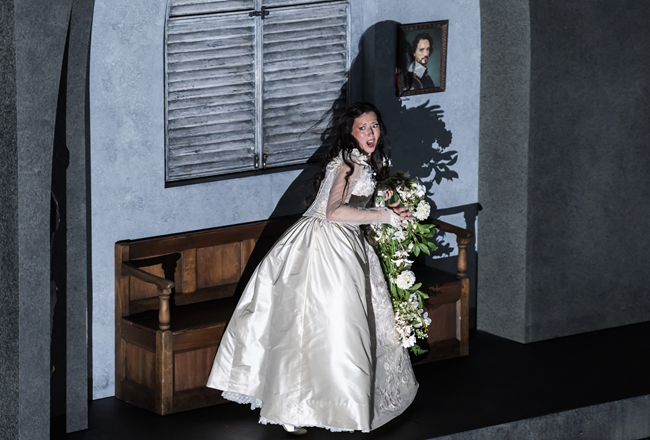
Elvira waits for Arturo to arrive for the wedding ceremony and it is soon realised that he has fled with the Queen. Distraught, she calls in vain for her lover.
 Act Two
Giorgio describes Elvira’s madness to the civilians and says that a sudden joyful or tragic experience alone may save her. Riccardo enters and declares that Arturo has been condemned to death for his part in Enrichetta’s escape from imprisonment.
Elvira enters, and is unable to recognise Riccardo. The two men are driven to tears by her despair, and Giorgio persuades Riccardo to try and save Arturo, for the sake of Elvira, and they make a blood pact.
Act Three
Three months later, Arturo returns to the fortress. He looks for Elvira, singing to attract her notice, while hiding from the soldiers. Arturo finds her in the Valton family tomb, gazing at the skulls of her ancestors, and he reveals that the woman he had helped to escape was the Queen, that he loves only Elvira, and declares that they will never be parted. Elvira is driven to distraction by the sounds of the approaching soldiers. On discovery of the couple, the soldiers shackle Arturo for his impending execution.
Arturo bemoans the miserable fate of himself and Elvira, but the soldiers insist that the death sentence be upheld. Riccardo steps up to shoot his rival, but Giorgio intervenes. A messenger arrives with the news that the Royalists have been defeated and that Oliver Cromwell has issued a general pardon. In the midst of Elvira, Arturo, and the chorus’ joy, a still-vengeful Riccardo stabs Arturo.
Performance
Bleak was the aspect for this staging of I puritani. Richard Jones and Hyemi Shin settled on sandbags piled high, walls stained with cannon smoke, and Gothic arch windows to signify the inner courtyard of a fortress. A cannon completes the scene and hastily strung-up garlands of leaves and flowers suggest the civilian chorus’ best efforts to celebrate a marriage under wartime conditions. An inner chamber represents at once Elvira’s dressing room, complete with a framed painting of Lord Arturo Talbo; the apartment in which Enrichetta di Francia is imprisoned; and, in Act Three, the Valton family tomb. It functions throughout the opera as a space of intense emotional encounter – between Elvira and her uncle, her lovers, and between Arturo and the widowed Queen.
Elvira’s dress changes from a moody purple to a joyous yellow and finally to a pure white wedding dress in Act One as she ecstatically welcomes the news that she can marry Arturo and eagerly awaits the wedding ceremony. In Acts Two and Three, this wedding dress – much like that of Miss Havisham in Charles Dickens’ Great Expectations (1861) – appears in increasingly blackened and ruined form, reflecting her descent into madness and diminishing hopes of Arturo’s return. Nicky Gillibrand also creates an effective visual juxtaposition between the Roundheads and Cavaliers, with drab uniforms for the Puritan soldiers and gaudy waistcoats, striped trousers, and elaborate hats for the Royalists. The chorus are transformed from civilians to soldiers in Act Two by the simple addition of period helmets.
In Act Three, Arturo, clutching a haunted Elvira, is hunted down by the soldiers and shackled to a shooting range. The jealous Sir Riccardo Forth steps forward to take shot at his rival – in total defiance of the blood pact established with Elvira’s uncle in the previous act and of Bellini and his librettist Carlo Pepoli’s original narrative. Saved from gunfire on this occasion by the watchful Sir Giorgio Valton, Arturo is stabbed by Riccardo on the final orchestral chord, which – gratuitously and rather heavy-handedly – denies the production and audience the closure of the opera’s harmonious ending.
Singers and Orchestra
The stand-out performance of the night was undoubtedly that of Lisette Oropesa as Elvira. The role’s virtuosic set pieces and scalic runs appeared effortless and demonstrated Oropesa’s fantastic vocal control. Her characterisation of the young bride was masterful, particularly during Act Two when Elvira’s mental instability is at its height. Marcela Rahal also gave an outstanding performance as Enrichetta di Francia, with a commanding presence and powerful tones worthy of the grieving queen.
Francesco Demuro flaunted a formidable tenor range as Lord Arturo Talbo and was well-matched in Act Three by Andrzej Filończyk’s Sir Riccardo Forth in the love rivalry that, in this production, was sustained into its final moments. They were ably supported by Ildebrando D’Arcangelo as Sir Giorgio Valton, who was a caring and attentive uncle to Elvira, by Blaise Malaba as Lord Gualtiero Valton and by Giorgi Guliashvili as Sir Bruno Roberton.
The Royal Opera Chorus, directed by William Spaulding, should be applauded for its rich sound and active part in the stage business, tortured and enraged by the news of Elvira’s apparent neglect by Arturo. The Orchestra of the Royal Opera House was also on fantastic form – the warm brass tones are especially worthy of mention – and was expertly conducted by Riccardo Frizza.
Conclusion
This was a very welcome production of I puritani, thirty-five years since its last staging at Royal Ballet and Opera. Oropesa’s outstanding performance guaranteed its success and was, rightly, heavily applauded by an enraptured audience.
Rebecca Severy MA MPhil
PhD Candidate in Music, University of Cambridge
Photograph: Tristram Kenton
Photo: Lisette Oropesa (Elvira)