
by Richard Wagner (1813-1883), music drama in three acts, libretto by Richard Wagner; premiered 16 August 1876 at the Bayreuth Festspielhaus
Set designer: Rufus Didwiszus, Costume designer: Victoria Behr, Lighting designer: Alessandro Carletti
Conducted by Antonio Pappano, Orchestra of the Royal Opera House and choir, Concert Master: Magnus Johnston
Soloists: Andreas Schager (Siegfried), Peter Hoare (Mime), Christopher Maltman (Der Wanderer), Elisabet Strid (Brünnhilde), Christopher Purves (Alberich), Soloman Howard (Fafner), Illona Linthwaite (Actor (Erda)), Wiebke Lehmkuhl (Erda), Sarah Dufresne (Woodbird).
Performance attended: 17 March 2026 (premiere)
 Summary of the action
Act One
Deep in the forest, the dwarf Mime is busy at work on a sword for Siegfried, the orphan child of the Wälsung twins Siegmund (killed by Wotan in Die Walküre) and Sieglinde (died in childbirth). Mime has raised Siegfried in order that he might kill Fafner – the giant, who, having transformed himself into a dragon, has kept watch over the Nibelung hoard, including the Tarnhelm and the ring, since Das Rheingold. Mime, the brother of Alberich (who took the gold from the Rhine at the start of the cycle), desires the ring for himself, to rule over his brother and the whole world.
Siegfried enters boisterously and, testing the sword newly-welded by Mime, instantly breaks the sword with his superhuman strength. Mime complains about Siegfried’s ingratitude and lack of love for his parental figure. Siegfried demands to know about his father and mother and, after much resistance, Mime is forced to reveal how Siegfried came to be in his care and shows Siegfried the fragments of Nothung, his father Siegmund’s sword. Siegfried declares that Mime must reforge Nothung and dashes off into the forest, leaving Mime to lament that he is unable to make this sword whole.
Der Wanderer (Wotan) enters, and challenges Mime to a battle of wits. He wagers his head on his ability to answer correctly any three questions asked by Mime. Reluctantly, Mime agrees and questions Der Wanderer on each of the races that live in the world. Der Wanderer then commands Mime to answer three questions of his own. Mime is whipped into a frenzy and unable to answer the third and final question: who is able to repair Nothung? As he departs, Der Wanderer tells the dwarf that only he who has not experienced fear will be able to reforge the sword and is also he to whom Mime’s head is now forfeit. Mime realises that this one must be Siegfried.
Siegfried returns and Mime plots to instil fear in the hero – thereby saving his own head – by leading him to the dragon Fafner. Siegfried agrees to the plan, determined to learn what ‘fear’ is, and, exasperated with Mime’s slow progress on Nothung, forges anew the sword himself. Mime, meanwhile, gleefully prepares a drink with which to poison Siegfried once he has killed the dragon.
Act Two
Der Wanderer stumbles across Alberich, keeping watch outside Fafner’s den. Alberich reveals his intent to seize the ring and rule over the world, while Der Wanderer insists that he will let matters take their course, without interference. They attempt to bargain with Fafner, who dismisses the threat to his life posed by the approach of Siegfried.
Siegfried arrives to wait for Fafner, while Mime hides himself away in fear. The hero wakes the dragon with a call on his horn, and Fafner appears from his lair. Siegfried stabs the dragon with Nothung and, in his last moments, Fafner reveals the ring’s curse. Siegfried tastes the dragon’s blood and finds that he is able to understand the call of the Woodbird, which instructs him to take the ring and Tarnhelm from the Nibelung hoard.
Mime and Alberich appear from nearby and argue over the gold. While Alberich hides, Mime approaches Siegfried and attempts to persuade him to take the poisoned drink. Siegfried finds that the dragon’s blood has also made him able to hear Mime’s murderous thoughts and stabs Mime to death. The Woodbird returns and tells Siegfried of a woman (Brünnhilde) sleeping within a ring of magic fire, through which only the greatest of heroes could break. Siegfried follows the Woodbird to the sleeping Brünnhilde.
Act Three
Near Brünnhilde’s resting place, Der Wanderer calls up Erda, against her will, from the depths of the earth. Erda is unable to offer any wisdom and Der Wanderer declares that he no longer fears the twilight of the gods, but rather wills it. Erda crawls back into the earth and Siegfried arrives en route to the ring of fire. Siegfried taunts Der Wanderer, unaware of who he is, and, when the old man blocks his path, breaks his magic spear with the force of Nothung.
Siegfried travels on, passes through the fire without fear, and finds Brünnhilde, asleep and in full armour. As Siegfried removes the armour, he realises that the figure before him is that of a woman and not a man. Struck suddenly by fear and love, he kisses Brünnhilde, who awakens from her magic sleep. They reveal their love for each other and Brünnhilde, at first hesitant, ultimately renounces the gods, her powers as former Valkyrie, her maidenhood, and independence.
Performance
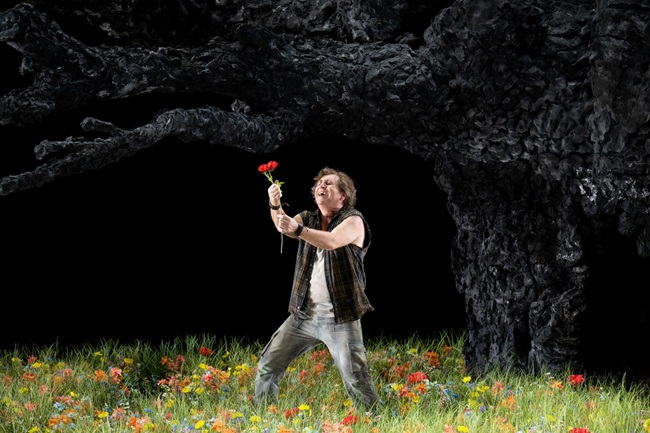
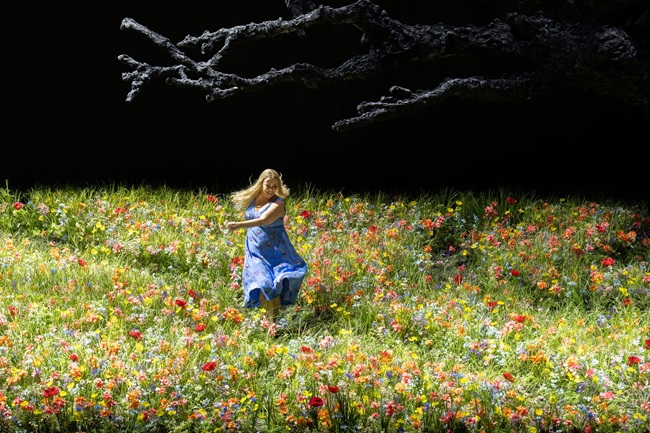
The natural landscape takes centre stage in this production of Siegfried. The ecological catastrophe that characterised this cycle’s first two dramas is here arguably less explicit, instead centred in the characters and their relations with Mother Earth. Siegfried revels in nature – in the snowy expanse of Act Two as he waits for Fafner to emerge from his lair; in the spectacular Edenic meadows of Act Three as he frolics, like Adam, with Brünnhilde, his Eve; and in his loving affection and respect for Erda, overlooked by all others on stage. Siegfried’s one moment of stillness with Mime, in Act One, also relates to nature. The labour of Sieglinde, Siegfried’s mother, is quietly, thoughtfully enacted by the characters, and lends their relationship a greater depth and psychological complexity. Their respective activities towards the close of Act One – Siegfried hammering away at Nothung on Mime’s forge, while the Nibelung merrily chops up herbs for a poison-laced broth in time with the orchestral score – are carried out in a bustling harmony at odds with their enmity and renders their lengthy, strained familiarity believable.
In Act Two, the action centres around a bench to the right of a snowy track outside Fafner’s den, lit by a dingy street lamp. All those who hanker after the ring – Alberich, Wotan (Der Wanderer), and Mime – return in succession to this seat, to argue, plot, and ignore Erda, often found cowering between them. Gods and dwarves are here shown to be equal in their degradation, and the emergence of Fafner in a brilliant gold costume and skeletal aspect visually demonstrates another character eaten up by his desire for possession of the golden hoard.
Act Three opens with Erda covering her face in a position of lamentation now well known to those who have witnessed this cycle’s Das Rheingold and Die Walküre. Wotan strides on and drags a second manifestation of Erda – the mother of the punished Brünnhilde – from the womb of the earth (or a carefully hidden trap door) and treats her roughly, with disdain. As he throws her to the ground, Erda screams and a prolonged and total silence is maintained by the orchestra, by the cast on stage, and by the audience. The disregard for nature displayed throughout culminates here. In the final scene, Siegfried, Brünnhilde, and a silent Erda gambol in paradise garden, but its very abundance, together with a crafty lifting of the black backcloth to reveal the backstage area and stark perimeter of this paradise, suggests its transience, artificiality, and disconnection from the realities of the cycle’s world and prepares for the Fall to come in Götterdämmerung.
Singers and Orchestra
Andreas Schager gave a truly stand-out performance as Siegfried in this production. Boisterous and serene, charming and moody, callous and tender, Schager teased out all the dimensions of Wagner’s complex titular character, while his voice rang out with bell-like clarity across the auditorium and captivated the audience. His interactions with Peter Hoare’s twitching and scratching Mime were highly comical, but not inhumane, and allowed the hero – so easily portrayed as a rather one-dimensional, self-centred brute – to be sympathetic in some degree.
Christopher Maltman was a commanding and fantastically shabby Wanderer and well-paired by Christopher Purves as Alberich. The squabbling of these two characters, slumped on a bench with a packet of crisps and waiting for Siegfried (or perhaps a bus) to come along, was engaging and reinforced latent thematic correspondences between the figures, their actions, and yearnings after power. Soloman Howard returned as Fafner with rich, liquid bass tones, while Elisabet Strid also returned to the cycle as a wilful and passionate Brünnhilde. Actor Illona Linthwaite resumed her silent, poignant commentary as Erda on the unfolding narrative, and was joined by Wiebke Lehmkuhl for a fierce confrontation with Wotan (Der Wanderer) at the start of Act Three. Sarah Dufresne was an enchanting Woodbird and Siegfried’s tenderness towards the Woodbird, Erda, and the natural landscape as a whole was a delight to watch.
The Orchestra of the Royal Opera House was on stellar form, with a sensitive, full-bodied, luscious sound, and expertly directed by Conductor Laureate Antonio Pappano.
Conclusion
This was a fantastic performance and interpretation of Siegfried. The attention and sensitivity to the complexities of the narrative, to the psychologies of Wagner’s characters, and to the richness of his opera poem elevated the production. Andreas Schager made a masterful Royal Opera House debut and the performance closed to thunderous applause.
Rebecca Severy MPhil BA (Hons)
PhD Candidate in Music, University of Cambridge
credit The Royal Opera ©2026 Monika Rittershaus
Photos: Andreas Schager (Siegfried), Elisabet Strid (Brünnhilde)